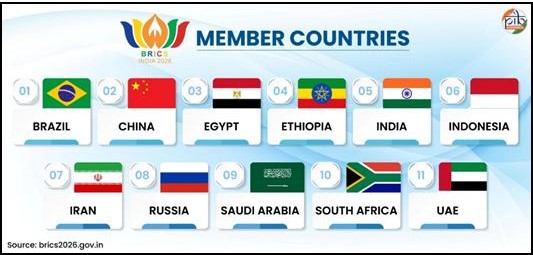
India hosted the 18th BRICS Summit in New Delhi on 12–13 September 2026 under its BRICS Chairship.The summit adopted the New Delhi Declaration and focused on strengthening cooperation among emerging economies and amplifying the voice of the Global South.
Theme
“Building for Resilience, Innovation, Cooperation and Sustainability” was the theme of India’s 2026 BRICS Chairship and the 18th Summit.
- Resilience: Strengthening economic, social, climate and institutional capacity against global shocks.
- Innovation: Promoting technology, AI, research, startups and digital transformation.
- Cooperation: Deepening political, economic, financial and people-to-people partnerships.
- Sustainability: Advancing climate-resilient, inclusive and sustainable development.
India as BRICS Chair — 2026
- India assumed the BRICS Chairship for 2026, with a people-centric and humanity-first approach.
- India prioritised Resilience, Innovation, Cooperation and Sustainability throughout its presidency.
- More than 400 BRICS meetings and engagements across around 30 Indian cities were held during the chairship.
- India sought to position BRICS as a practical, development-oriented and solutions-driven platform for the Global South.

Major Outcomes / Agenda of the 2026 Summit
Global South & Global Governance
- BRICS reaffirmed its role in representing the interests and priorities of emerging and developing economies.
- Members supported comprehensive reform of the UN and UN Security Council to increase representation of developing countries.
- China and Russia reiterated support for the aspirations of India and Brazil to play a greater role in the UN, including the UNSC.
Digital Public Infrastructure
- BRICS recognised the potential of safe, inclusive and interoperable Digital Public Infrastructure (DPI) for large-scale delivery of public services.
- The grouping noted proposals for a BRICS DPI repository and pilot DPI projects.
- Cooperation will also focus on digital skills, connectivity and capacity building.
Innovation & Technology
- Greater cooperation was supported in AI, Industry 4.0, startups, SMEs and emerging technologies.
- BRICS emphasised development of safe, reliable, inclusive and trustworthy AI, particularly for the Global South.
Financial Cooperation
- Members continued discussions on cross-border payment interoperability.
- BRICS also discussed greater use of local currencies for trade settlements and investment, while recognising national priorities.
- The summit welcomed progress on the BRICS Multilateral Guarantees initiative to mobilise private capital and lower financing costs for development projects.
Resilient Supply Chains & Critical Minerals
- Members called for diversified, resilient and sustainable critical-mineral supply chains.
- BRICS emphasised value addition, economic diversification and the sovereign rights of resource-rich countries over their minerals.
Energy Transition
- Cooperation will focus on energy security, resilient energy supply chains and low/zero-emission technologies.
- BRICS supported cooperation on hydrogen standards and hydrogen value chains.
Climate Action & Green Finance
- BRICS reaffirmed commitment to the Paris Agreement, including mitigation, adaptation and climate finance.
- Members supported greater climate financing for developing countries and people-centric, community-based adaptation.
- Cooperation on carbon markets and climate-resilience mechanisms was also strengthened.
Multilateral Reforms
- BRICS called for a more democratic, representative and effective multilateral system.
- Reform of institutions such as the UN, UNSC and global economic governance structures remained a central priority.
Significance of the Summit
- Global South: Strengthens the collective voice of developing and emerging economies in global governance.
- Economic Cooperation: Promotes trade, investment, local-currency settlements and financial connectivity.
- Digital Cooperation: Positions DPI and digital inclusion as important BRICS development tools.
- Climate & Energy: Promotes energy security, climate resilience and sustainable transition.
- Critical Minerals: Supports diversified supply chains needed for clean-energy and high-technology industries.
- Innovation: Expands cooperation in AI, startups, research and advanced technologies.
- India’s Global Role: Reinforces India’s position as a key bridge between the Global South and major global powers.
- Institutional Evolution: The 2026 summit marked two decades of BRICS cooperation; 2026 is also 25 years since the term “BRIC” was coined in 2001.
BRICS Outreach and Bangladesh
- India also hosted an Outreach/BRICS Plus Dialogue involving partner countries and invited regional representatives.
- India had invited Bangladesh Prime Minister Tarique Rahman in his capacity as BIMSTEC Chair, but Dhaka ultimately did not send him to the summit amid strains in India–Bangladesh relations.
- The episode reflected wider bilateral irritants involving Sheikh Hasina’s presence in India, water-sharing issues and political trust, even as both sides continue to recognise the importance of economic and geographical cooperation.
The New Delhi BRICS Summit sought to move the expanded grouping from dialogue towards practical cooperation, with India emphasising Global South representation, resilient supply chains, DPI, innovation, climate action and reform of global governance.


.svg.png)


